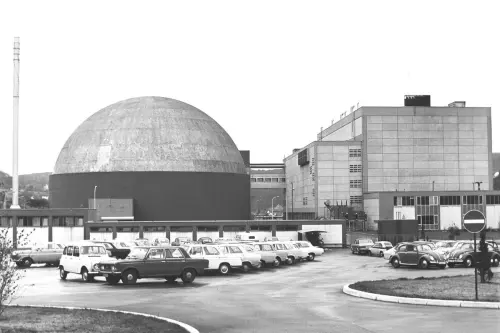
 The Obrigheim nuclear power plant went live in September 1968, with its dome having been sealed with MC’s NAFU system. This photo was taken before application of the coating. The NPP was eventually shut down in 2005.
A recently developed technology referred to as the NAFU system was acquired by the sales company Prodorit-Vertrieb Müller & Co. KG, which MC founder Heinrich W. Müller managed for Mannheim-based Th. Goldschmidt AG. NAFU is the brand name for a seamless and jointless roof protection system. It is installed in several layers with cold- and/or hot-applied NAFUPLAST coating compounds (mainly based on bitumen and polymer-modified bitumen), embedding reinforcing fabrics within its structure. Compared to the roofing membranes used until then, the new coating from MC opened up completely new perspectives in industrial and residential construction, primarily for flat roofs, but also for domed roofs.
The trend towards flat roofs
The flat roof finally became established in Germany in the 1950s. At the 1958 World Expo in Brussels, Germany presented a flat-roof pavilion designed by the architects Eiermann/Ruf, which was characterised by its particular lightness. By the 1960s, flat roofs were already enjoying great popularity – both in the industrial and private sectors. But this roof construction also harbours risks for the building structure underneath, since rainwater, for example, may not be completely drained off, unlike in the case of pitched roofs. The demands on the roof’s waterproofing system are therefore particularly high, and regular inspections are imperative. This is especially true for older roofs – because once the insulation becomes soaked, the only option is to dismantle and remove.
MC gains a foothold in the power plant sector
It was precisely here that MC found its market: The NAFU system has the great advantage over prefabricated membranes that it has neither seams nor overlaps and thus offers no points of attack from wind and rain, nor for moisture penetration – to the beneft not just of flat roofs, but also of domed roofs. The reactor dome of the first German nuclear power plant in Obrigheim in the Neckar-Odenwald region became the first, literally outstanding, reference object for this MC coating system.This successful project provided a huge boost for the further marketing of NAFU roofs across the entire German power plant sector.
NAFU and its successors
Up until the 1980s, countless roof surfaces, especially those with complicated constructions, were successfully protected with NAFU. After that, legislators, planners and architects began to put more and more emphasis on the thermal and cold protection of flat roofs, and MC turned to accommodating these and other areas of application.
The advent of NAFU led to the development of the MC-Proof family of building waterproofing systems for structurally demanding surfaces, plus special systems for waterproofing wet rooms, balconies and terraces, in which MC’s sister company Botament also specialises. This gave rise to the bitumen-free, solvent-free thick-film coatings under the brands MC-Proof eco and RD2 at the beginning of the 2010s, with which both companies revolutionised and benefited the building waterproofing market.
 Germany
 Austria
 Belarus
 Belgium
 Bosnia and Herzegovina
 Bulgaria
 Croatia
 Czech Republik
 Denmark
 Finland
 France
 Georgia
 Great Britain
 Hungary
 Ireland
 Latvia
 Lithuania
 Netherlands
 Poland
 Portugal
 Romania
 Serbia
 Slovakia
 Spain
Spain
 Sweden
 Switzerland
 Ukraine
 Ethiopia
 Ghana
Ghana
 Guinea
 Israel
 India
India
 Malaysia
 Singapore
 United Arab Emirates
 Vietnam
 Taiwan
 Philippines
 New Zealand
 Australia
 Canada
 Brazil
 Chile
Chile
 Bolivia